


Do you have an issue with a Masonry structure that is leaning?
Brick mailboxes, columns, planters, and almost anything built with brick or stone needs a concrete footing–a foundation–to support it. We’ve all seen leaning mailboxes and columns, cracked and shifted planter boxes, and other masonry structures falling or shifting. This is almost always due to an absent or inadequate foundation.
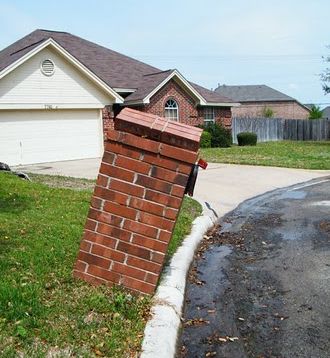
Brick Doctor builds and repairs a lot of brick mailboxes. One of the afflictions we see too much of, are mail boxes built without an adequate foundation. We have quite specific information on brick mailbox fundamentals, including foundations, here.
If you are considering building anything new with brick or stone, insist on knowing the details of how the foundation will be built as well.
Why Do So Many Structures End Up with Structural Problems?
Some homeowners may knowingly cut corners to cut the price of projects, but any reputable contractor should advise against skimping on the foundation. Few brick masons may be familiar with the importance or the principles of building a proper foundation, as typically a concrete contractor would be responsible for building that portion of a new building. But any responsible contractor building small projects should be well-aware of this critical step.


For even the smallest of structures, the concrete foundation should be a minimum of four inches thick, with steel rebar reinforcements to help prevent cracking and separating. Taller, heavier structures need deeper foundations to maintain their plumb (straight up and down) and level position over time.
New Additions Must be Built with Considerations for Differential Movement
A structure that is added on, such as a room addition or patio extension, should be designed to accommodate slight movements between it and the original construction. Expansion joints in the masonry at those junctures help control unsightly cracks, and can also help prevent water penetration.
